
In Shenzhen, science "lives in the future"
May 06, 2026
John Roger Speakman, chief scientist of the Institute of Biomedicine and Biotechnology at Shenzhen Institutes of Advanced Technology (SIAT) of the Chinese Academy of Sciences, and a foreign member of Chese Academy of Sciences:
In Shenzhen, science 'lives in the future'
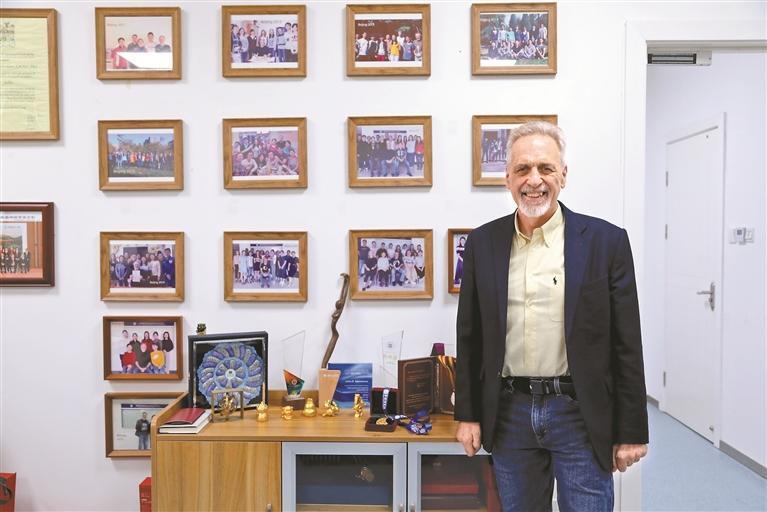
The photos on Prof. John Roger Speakman's office walls silently narrate a 15-year odyssey in China. One wall chronicles his journey in Beijing from 2011 to 2020, where his team grew from a single assistant and two students into a robust research group. The opposite wall marks his new chapter in Shenzhen: in 2020, he joined the Shenzhen Institutes of Advanced Technology (SIAT) of the Chinese Academy of Sciences. By last year, his team had grown to 35 members.
"This is the evolution of my life in China," Speakman said with a smile. "And Shenzhen is the most vibrant chapter of my story."
From the U.K. to Beijing, and finally to Shenzhen, every move by this world-class scientist has been driven by one goal: to dedicate his life to genuine scientific inquiry. In Shenzhen, he has not only established China's first human doubly labeled water laboratory — addressing critical questions about obesity and metabolism — but has also found a way to live and work "in the future."
Speakman is a known rule-breaker in the lab. For decades, the "thrifty gene" hypothesis dominated the study of obesity's evolutionary mechanisms. Through rigorous theoretical derivation and data analysis, Speakman identified fundamental flaws in that theory and proposed the "drifting gene" hypothesis, opening an entirely new frontier in understanding how obesity evolved.
His most acclaimed contribution is the advancement of the doubly labeled water technique as the gold standard for measuring energy expenditure. Having worked on this method since 1986, he launched China’s first human doubly labeled water laboratory in Shenzhen in 2020.
Using this technique, his team achieved two groundbreaking discoveries published in journal Science. In 2021, they revealed metabolic patterns across the human lifespan, overturning the long held belief that metabolism slows down in middle age. They proved that middle aged weight gain is driven by increased food intake rather than a biological metabolic decline. In 2022, his team published another study debunking the common wisdom that humans require "eight glasses of water a day."
Now 68, Speakman reflected on his departure from a top U.K. university, where he served as a research institute director. "If I had stayed in the U.K., rising further up the academic ladder to become a dean, I would have had no time for research at all," he explained. "I wanted to use all my time for science. China, and especially Shenzhen, provides the opportunity to realize that dream."
His advocacy for science extends beyond the laboratory. At a symposium for foreign experts at the Great Hall of the People in Beijing earlier this year, he urged reform of the research funding system. He suggested establishing stable, specialized funding that grants researchers autonomy and reduces administrative burdens. "We need to free scientists from heavy paperwork so they can focus on their core research," he said.
Speakman's affinity for Shenzhen is both professional and personal. A one-week visit with his wife convinced him to move to the city, which impressed them as clean and livable.
However, it was Shenzhen's ubiquitous "sense of the future" that truly fascinated him. "Living in Shenzhen feels like living five years in the future," he said, citing driverless taxis, drone deliveries, and dancing robots as everyday realities for residents.
As Shenzhen prepares to host the 2026 APEC summit, Speakman sees the city as a living embodiment of "openness, innovation, and inclusiveness."
He believes maintaining an international vision is vital for attracting global talent and fostering collaboration. This was evidenced last year when he led Shenzhen's effort to host the 6th RACMEM (Recent Advances and Controversies in the Measurement of Energy Metabolism) conference — the first time this prestigious research event was held in China — attracting scholars from 21 countries.
His own research remains profoundly global, drawing on data from more than 5,600 participants from 26 countries. "Understanding human energy and water needs is vital for addressing global challenges such as the obesity crisis and food security," he noted.
Looking ahead to APEC 2026, Speakman has high hopes. "When delegates arrive, they will see a dynamic city of the future — a model for development in their own hometowns." He hopes to use the APEC platform to further deepen research collaboration and knowledge sharing in health sciences across the Asia Pacific region.
On October 20, 2003, Bangkok hosted the 11th APEC Economic Leaders' Meeting under the theme "A World of Differences: Partnership for the Future." The meeting focused on bolstering the knowledge economy and financial systems while addressing human security through the landmark APEC Action Plan for SARS.
Bangkok, the vibrant capital of Thailand, sits along the Chao Phraya River and stands as the second-largest city in Southeast Asia. It is the nation's undisputed heart — a hub for trade, culture, technology, education, and religion. Renowned as a premier destination for international exchange, the city hosts hundreds of global conferences each year. It is home to regional offices of major international bodies, including the U.N. Economic and Social Commission for Asia and the Pacific, the World Bank, and the WHO. Dubbed the "City of Buddhas," Bangkok harmonizes its rich religious heritage as the headquarters of the World Fellowship of Buddhists with its status as a modern center for research and technology.
"My wife goes for a walk in the park every day, and when I have free time, I take my camera to photograph birds. We have a very nice lifestyle," Speakman said.
File Download: