
Global 10m Resolution PV Power Plant Dataset (2019-2025): A Breakthrough via ANDPI and Multi-Source Data Fusion
Dec 05, 2025
As one of the most promising renewable energy technologies worldwide, photovoltaic (PV) power plays a pivotal role in achieving carbon neutrality, and accurately locating PV power plants and tracking their spatiotemporal expansion is essential for informed energy policymaking, industrial planning, and climate change mitigation. However, with the rapid global surge in PV installations, existing geospatial datasets suffer from significant limitations—including restricted spatial coverage, insufficient resolution, and a lack of timely updates—making them increasingly inadequate for current research and practical needs.
A team led by Associate Professor SUN Liqun from the Institute of Technology for Carbon Neutrality, Shenzhen Institutes of Advanced Technology (SIAT), Chinese Academy of Sciences, developed a 10-meter resolution global dataset of centralized PV power plants.
The study published in the journal International Journal of Applied Earth Observation and Geoinformation(JAG).
The team proposed an innovative "adaptive index + multi-source data fusion" framework that delivers strong performance with a streamlined design by integrating multiple strengths into a coherent workflow. Specifically, they fused three key datasets—TZ-SAM for global localization, ChinaPV for 10 m high-precision mapping in China, and GlobalPV for global time-series information—to achieve complementary synergy; they developed the Adaptive Normalized Difference Photovoltaic Index (ANDPI), which automatically separates PV from non-PV surfaces using bimodal distribution thresholding that adapts to diverse land-cover conditions; and they built an efficient fusion pipeline that preserves and optimizes historical data from 2019–2022 while updating the latest dynamics from 2023 to Q2 2025, ultimately producing global PV mapping results at 10 m resolution.
This comprehensive global dataset reveals clear patterns in the evolution of clean energy development. From 2019 to 2025, the total area of centralized PV power plants nearly doubled from 8,432 km² to 16,289 km², with China alone contributing 61% of the global increase. By Q2 2025, China's PV installation area had reached 8,358 km²—51.3% of the world total—surpassing the combined areas of the United States, Germany, and India. Notably, PV mega-complexes larger than 20 km² are primarily concentrated in northwestern China (Xinjiang, Qinghai, Gansu), as well as in the western United States, the Middle East, and northwestern India.
The dataset also highlights a rationalizing trend in land use: nearly 90% of global PV installations are located on rangeland (44.0%) or cropland (40.1%), and while cropland was slightly dominant before 2021, rangeland has become the primary land-cover type used for PV development since 2022, indicating a more balanced approach to reconciling energy expansion with food security.
This study not only fills critical data gaps in the PV sector but also offers actionable insights for clean energy development by supplying accurate evidence for global energy transition, demonstrating the low-cost scalability of multi-source data fusion for monitoring other renewables, and highlighting more balanced PV siting practices that reconcile energy expansion with ecological protection.
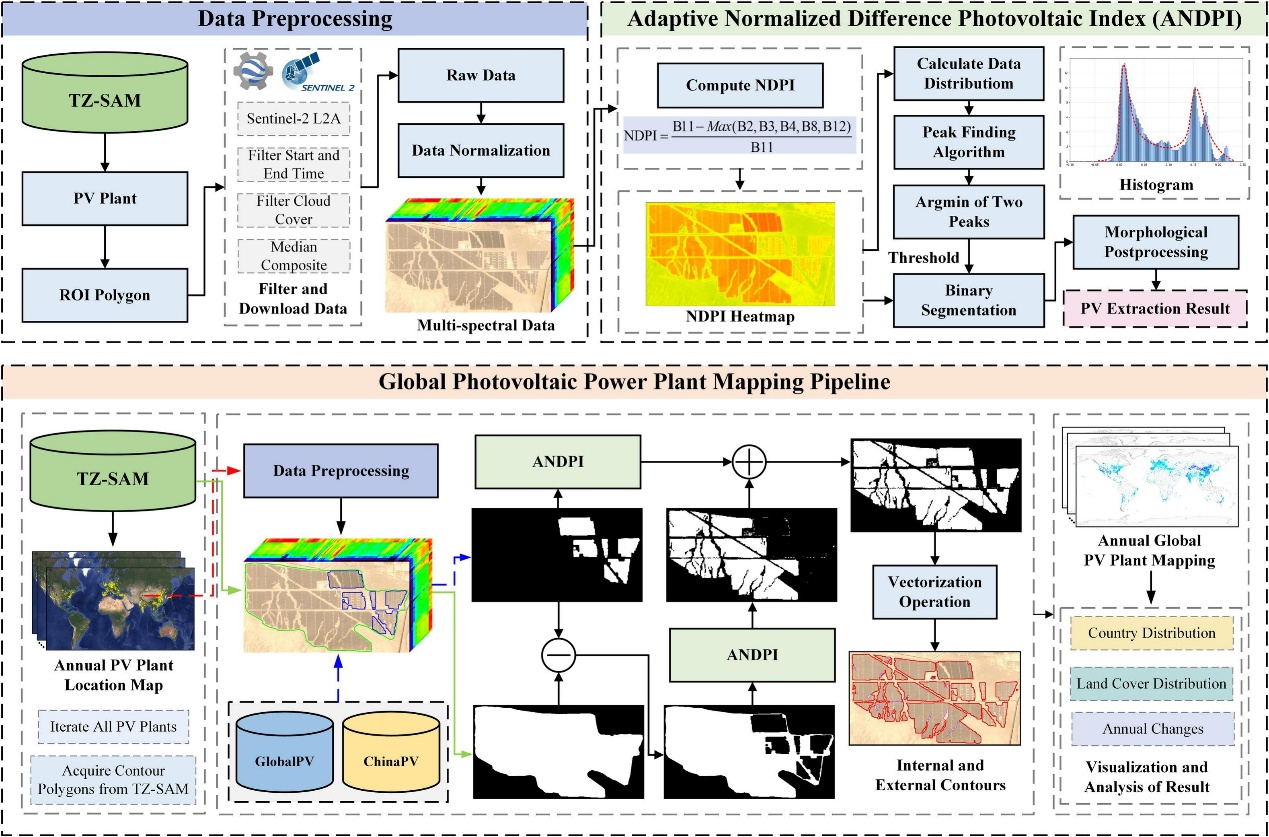
Schematic diagram of the "adaptive index + multi-source data fusion" framework. (Image by SIAT)
File Download:
Media Contact
YU Rong
Email:
rong.yu@siat.ac.cn
rong.yu@siat.ac.cn
More on this News Release
JOURNAL
International Journal of Applied Earth Observation and Geoinformation
DOI
10.1038/s41586-025-09509-7
Related Articles

Jan 19, 2024
By modeling a complex multilevel mapping of structure-function-morphology information, PALH significantly enhances Alzheimer's disease diagnosis performance and identifies relevant connectivity pat...
Oct 12, 2023
"We believe this developed suRi method would greatly enhance the imaging performance of the DL-FPD based dual-energy CBCT systems in future," said Prof. GE.