
Premating Maternal Stress Induces Sex-Specific Emotional Changes
Dec 22, 2025
Women experience mood disorders at disproportionately high rates, and maternal emotional disturbances around pregnancy are known to increase children's vulnerability to neurodevelopmental and psychiatric conditions. Yet how maternal stress before conception can have lasting effects on offspring brain development and psychiatric-related behaviors in adulthood has remained unclear.
A collaborative team led by Prof. LIU Xin-an, Prof. CHEN Zuxin, and Prof. WANG Liping from the Shenzhen Institutes of Advanced Technology (SIAT), Chinese Academy of Sciences uncovered how psychological stress experienced by mothers before conception may shape the long-term emotional behaviors of their offspring and revealed a previously unrecognized brain–body mechanism linking maternal emotional states to adult behavioral outcomes in a sex-specific manner.
The findings were published in Molecular Psychiatry.
Researchers exposed female mice to chronic unpredictable stress before mating and followed their offspring across development to adulthood. The team found that maternal premating stress led to delayed neurodevelopment and pronounced sex-specific behavioral abnormalities in adulthood: female offspring displayed hyperactivity and social deficits, whereas male offspring showed strong anxiety-like behaviors. These behavioral differences were accompanied by marked changes in gut microbiota composition and metabolic profiles, particularly in males.
To test the causal role of the microbiota in shaping these outcomes, the researchers administered lactoferrin—a natural prebiotic widely used in infant nutrition—to the offspring. Lactoferrin significantly reduced anxiety-like behaviors in male offspring but showed minimal improvement in the altered behavioral phenotypes of females, pointing toward sex-dependent microbial and metabolic pathways. Multi-omics analyses further revealed that lactoferrin strengthened microbial network connectivity, enhanced immune-related metabolic pathways, and restored cerebellar Purkinje cell activity in male offspring, aligning with the behavioral rescue. The intervention also reinforced a coordinated "microbiota–metabolite–cerebellar molecular factor" network whose improved integration closely paralleled behavioral recovery.
This work establishes an integrated framework in which the gut microbiota mediates the intergenerational impact of maternal emotional stress through the neuro-immune-metabolic interaction network, providing mechanistic insight into how maternal premating stress shapes offspring psychiatric-related behaviors. The findings underscore the critical role of microbial homeostasis in maintaining brain–body network integrity and highlight microbiota-targeted strategies as promising avenues for early-life mental health interventions. The authors note that future research will aim to identify key microbial drivers responsible for these sex-specific behavioral trajectories.
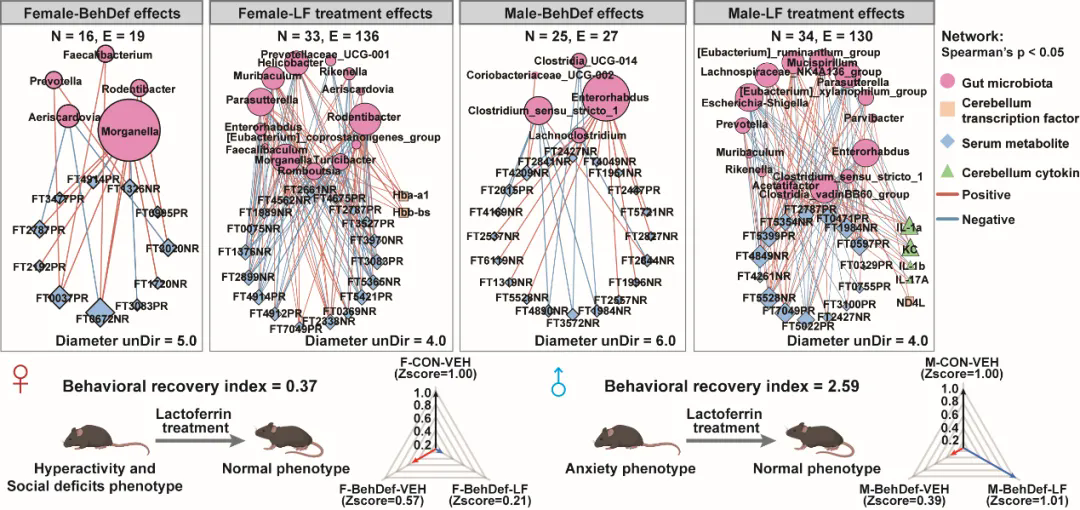
Improvements in psychiatric behavioral recovery in male and female offspring mice after lactoferrin treatment align with distinct, sex-specific microbiota–cerebellum–metabolic molecular network patterns. (Image by SIAT)
File Download: