
Composite Superionic Electrolytes for Pressure-less Solid-State Batteries Achieved by Continuously Perpendicularly Aligned 2D Pathways
Jan 19, 2026
Solid electrolytes are promising candidates for safe, high-energy battery systems. Composite solid electrolytes, in particular, hold the potential to combine high ionic conductivity with stable electrode interfaces. However, a fundamental trade-off often exists between ion conduction and mechanical properties.
In a study published in Nature Nanotechnology, a team led by Prof. CHENG Huiming and PENG Jing from the Shenzhen Institutes of Advanced Technology of the Chinese Academy of Sciences, along with Prof. HU Renzong from South China University of Technology, developed a composite electrolyte that decouples ion conduction from mechanical flexibility, achieving superionic conductivity while maintaining close electrode contact.
The composite architecture consists of alternating layers of perpendicularly aligned (PA) LixMyPS3 (LiMPS, M = Cd or Mn) nanosheets which establish continuous superionic conduction pathways, and polyethylene oxide (PEO) layers which ensure flexibility.
The PA-LiCdPS/PEO electrolyte achieved an ionic conductivity of 10.2 mS cm-1 at 25 °C, which is comparable to liquid electrolytes, while maintaining superior mechanical flexibility. A similarly designed flexible PA-LiMnPS/PEO electrolyte achieved an ionic conductivity of 6.1 mS cm-1 at 25 °C, confirming the generality of the structural design.
The PA-LiMPS/PEO electrolytes enabled high-performing all-solid-state batteries. Their flexible structure accommodated electrode volume changes without requiring external stack pressure. The PA-LiCdPS/PEO electrolyte enabled Li||LiNi0.8Co0.1Mn0.1O2 coin cells (stack pressure <0.5 MPa) to retain 92% capacity after 600 cycles at 0.2 mA cm-2, and facilitated the practical use of pressure-less (stack pressure <0.1 MPa) Li||LiFePO4 pouch cells.
Moreover, PA-LiMPS/PEO electrolytes demonstrated exceptional air stability. They retained high conductivity with negligible H2S release after seven days in humid air, in clear contrast to conventional sulfides that degrade within minutes. Most high-conductivity solid electrolytes require external pressure (ranging from several to hundreds of MPa), while these electrolytes enable stable battery operation without external pressure and complex fixtures, simplifying the design and manufacturing.
These findings of this study highlight the general design principles of the continuous superionic conduction pathways and biomimetic flexible structures, providing valuable insights into the practical development of all-solid-state lithium batteries.
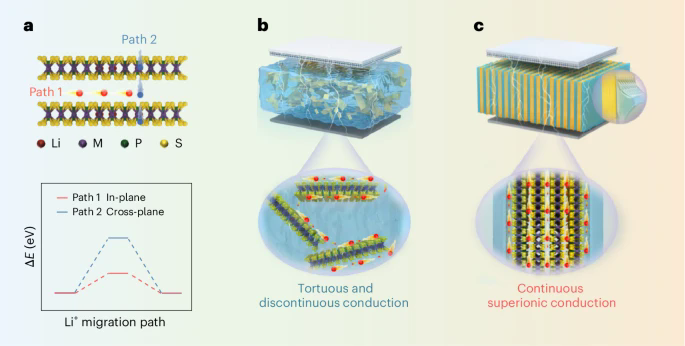
Anisotropy of Li+ conduction in 2D LiMPS and the construction of 2D CSCPs.(Image by SIAT)
File Download: