
Novel Ferroelectric Bioelectronic Interfaces Developed for Long-term Biosafe Vagus Nerve Modulation
Apr 10, 2026
Electrical stimulation of vagus nerve via implantable stimulators can effectively suppress inflammatory responses, offering a novel strategy for treating autoimmune diseases. However, traditional implantable stimulators face challenges in adaptive interfacing and communication with nerve tissues, significantly compromising in vivo long-term biosafety and efficacy.
A study published in Advanced Materials and led by DU Xuemin from the Shenzhen Institutes of Advanced Technology (SIAT) of the Chinese Academy of Sciences developed multifunctional ferroelectric bioelectronic interfaces (FBI) that integrates self- rolling, interfacial adhesion, and bioelectrical signals, enabling long-term biosafe vagus nerve modulation.
This FBI device features a three-layer composite structure. The substrate is a bilayer hydrogel made from natural polysaccharides-chitosan and functionalized alginate. Upon contact with water, it automatically rolls into a tube, conformally wrapping around delicate nerves as small as ~0.5 mm in diameter. The functionalized groups can form hydrogen bonds and covalent bonds with nerve tissue, providing stable fixation without sutures.
The upper layer consists of alternatingly arranged stripes of ferroelectric polymer poly(vinylidene fluoride-co-trifluoroethylene) and carbon nanotube composites (CNT/P(VDF- TrFE)). Under near-infrared (NIR) light, dipole switching within this layer generates biomimetic electrical signals that closely resemble neuronal action potentials induced by polarization changes.
The FBI can be remotely activated via NIR to effectively stimulate neural responses. It reduces cytotoxic reactive oxygen species levels by 16-fold compared to silicon-based optoelectronic materials.
In animal models, the FBI demonstrated long-term safety, stability, and durable efficacy in reducing inflammation. After 60-day implantation in freely moving rats, the FBI showed no signs of displacement. There was no nerve compression or local inflammation observed. Moreover, its anti-inflammatory efficacy remained consistent with initial performance.
By integrating precise geometric adaptability, seamless bioadhesive fixation, bioelectrical biomimicry, and robust biosafety, the FBI platform offers a new paradigm for next‑generation implantable bioelectronics for durable nerve modulation and treatment of neurological and autoimmune conditions.
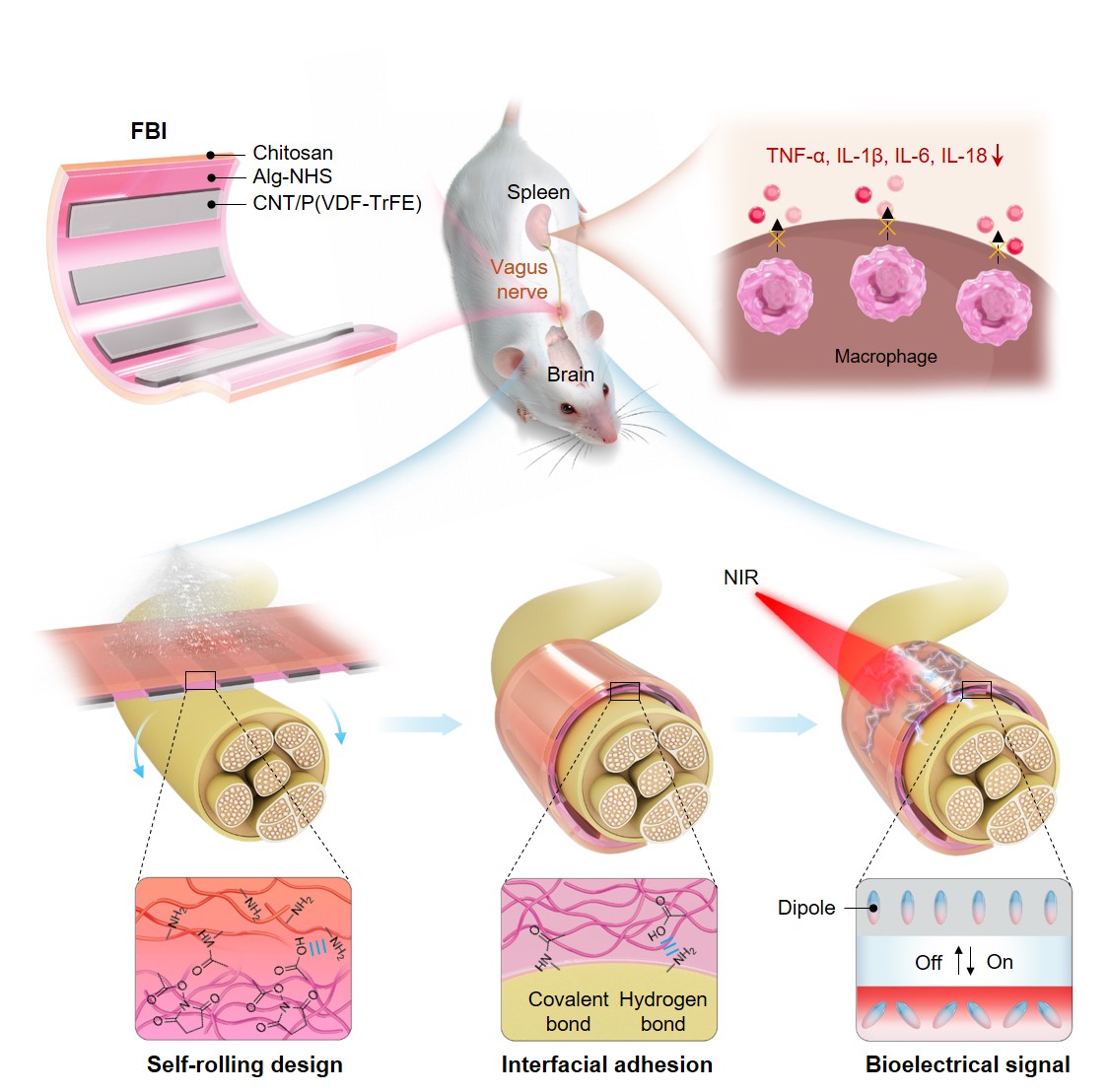
Design of multifunctional FBI. (Image by SIAT)
File Download: