
Wearable Microneedle Patch Turns Standard Ultrasound Probes into Continuous Glucose Monitors
May 19, 2026
More than 500 million people worldwide live with diabetes, making reliable continuous glucose monitoring (CGM) a critical yet unmet need. Nearly all commercial CGM devices depend on glucose oxidase enzymes that degrade within days to weeks, demanding frequent and costly replacements. Enzyme-free alternatives based on glucose-responsive hydrogels have shown promise, but have remained trapped between two imperfect readout options — optical methods prone to interference and toxicity concerns, and implantation-based ultrasound approaches that require invasive surgery.
Recently, a research published in Science Advances, Prof. MENG Long from the Shenzhen Institutes of Advanced Technology (SIAT) of the Chinese Academy of Sciences along with collaborators Prof. SU Zhongqing from the Hong Kong Polytechnic University, and Prof. Jae-Woong Jeong from the Korea Advanced Institute of Science and Technology (KAIST), developed the ARMPatch (Acoustically Readable Microneedle Patch) — a wearable, enzyme-free glucose monitor built entirely from glucose-responsive hydrogel microneedles.
Positioned between a standard ultrasound probe and the skin, the ARMPatch acts as an acoustically augmented interface: as the microneedles absorb interstitial fluid and swell in response to blood glucose fluctuations, the resulting length changes are directly quantified in real-time by any conventional ultrasound imaging system — no enzymes, no fluorescent dyes, and no custom hardware required.
The ARMPatch sustained stable glucose sensing for 56 days in laboratory tests and enabled 7 days of continuous glucose monitoring in freely moving animal models, with ultrasound-measured readings strongly correlated with a commercial glucometer. Acting as an "accessory" for standard ultrasound probes, this platform represents the first reported approach to continuous glucose monitoring driven by conventional ultrasound imaging, opening an entirely new avenue for ultrasound in wearable biosensing.
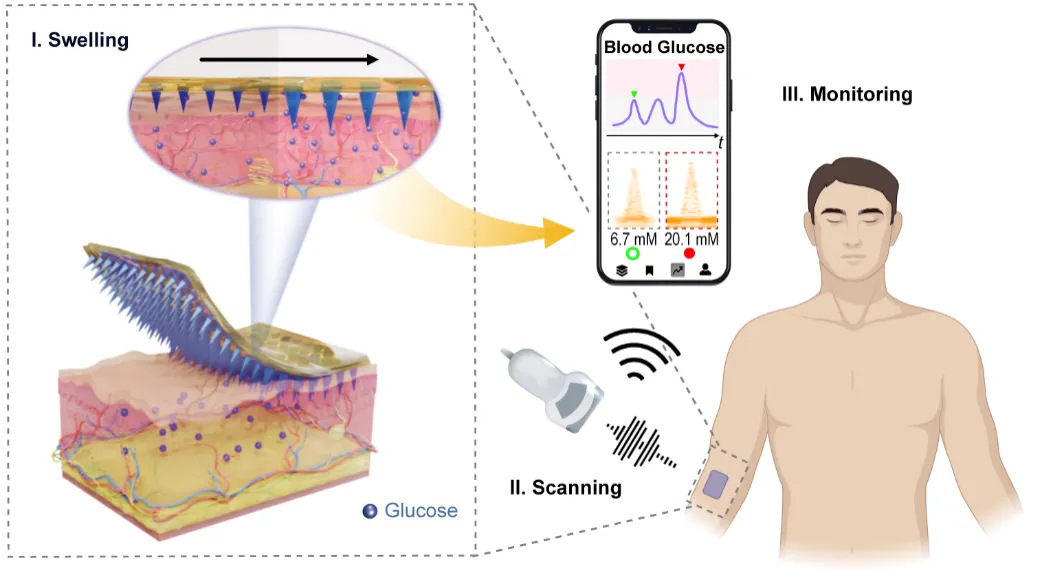
Schematic diagram of a continuous glucose monitoring system using a standard ultrasound probe combined with the developed ARMPatch, and a schematic diagram of the glucose-responsive mechanism of the synthetic hydrogel under glucose regulation.(Image by SIAT.)
File Download: